NCoDE Command connects to your onboard systems - legacy and modern - and brings their data into one unified, secure, customisable interface.
No more spreadsheet compliance. No more audit surprises. NCoDE Command handles incident reporting, patch management, training tracking, and backup verification β so your crew can focus on running the ship while shore manages compliance.
Maritime cyber attacks increased 103% in 2025. GPS spoofing now affects 40,000+ vessels daily. Ransomware has shut ports for days. The average attack costs $550,000 - and most vessel operators' insurance doesn't cover it.
The USCG cybersecurity rule took effect July 2025. Cybersecurity plans must be submitted by July 2027. NCoDE Command maps every requirement β from CySO designation to incident reporting β into guided workflows with audit-ready evidence.
15 requirements mapped. CySO tracking, cybersecurity plans, NRC reporting with 30-day follow-up, drill scheduling, and technical control evidence.
Three-stage CSIRT reporting β 24-hour early warning, 72-hour detailed notification, 30-day final report. All 10 Article 21 measures tracked.
NIST framework for maritime. SMS chain reporting β Captain to DPA to Company. ISM Code integration and flag state notification.
NCoDE Command runs on the MX100 - our high-performance onboard platform built for the processing demands of real-time compliance, multi-framework governance, and enterprise vessel operations. The MX100 collects data from your marine systems (NMEA 2000, Modbus, J1939), processes it in real time, and delivers it to Command for visualisation and management.
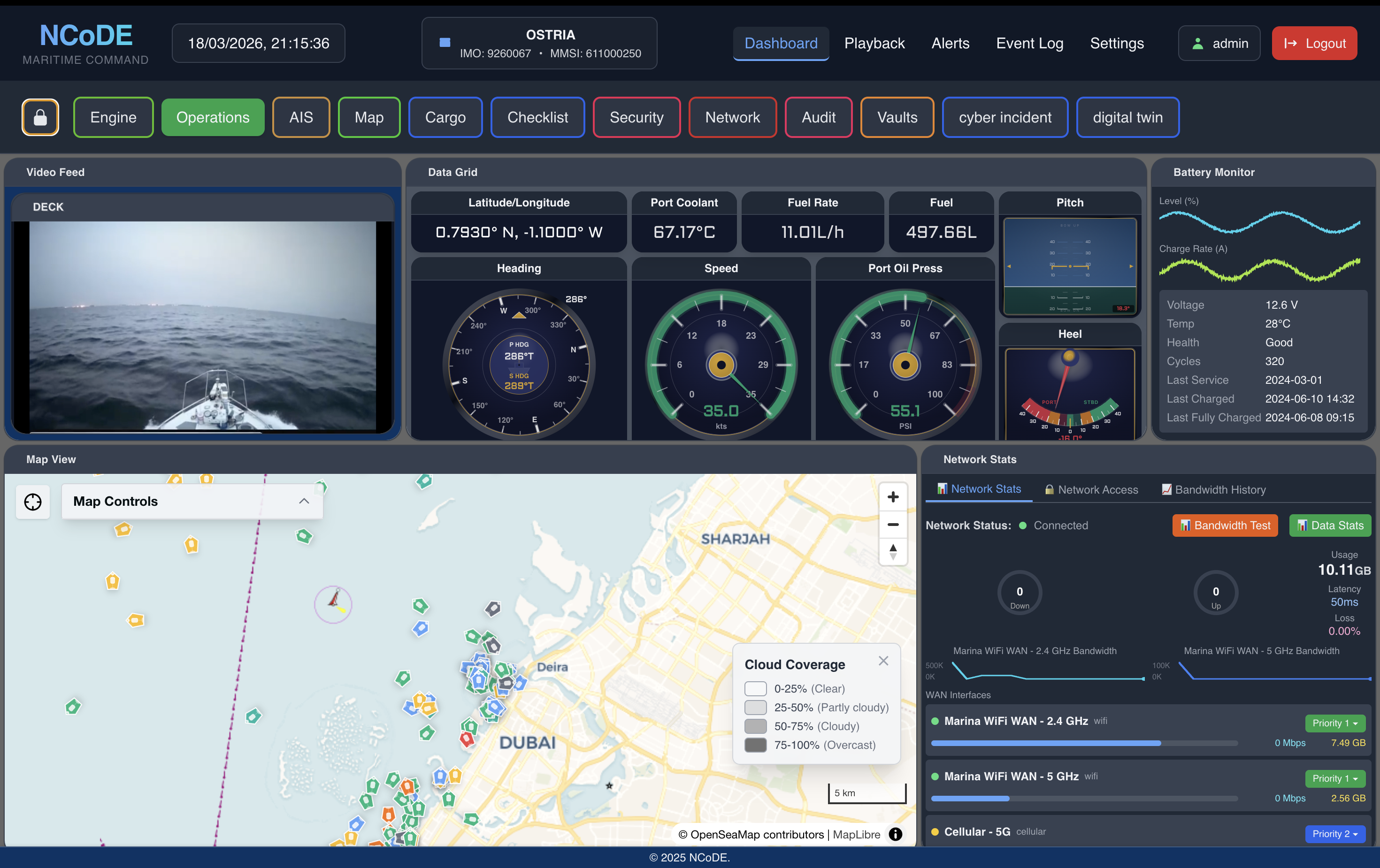
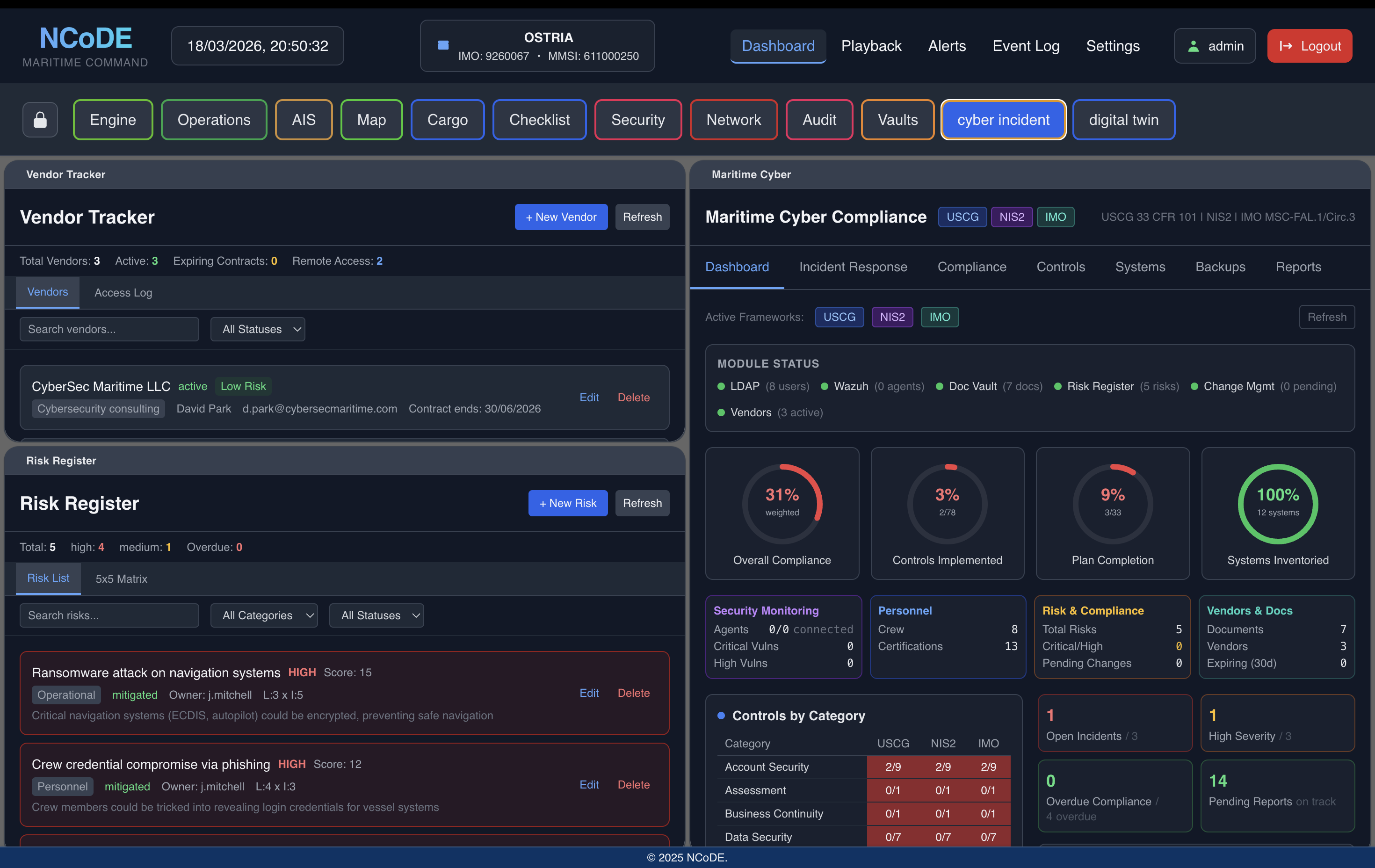
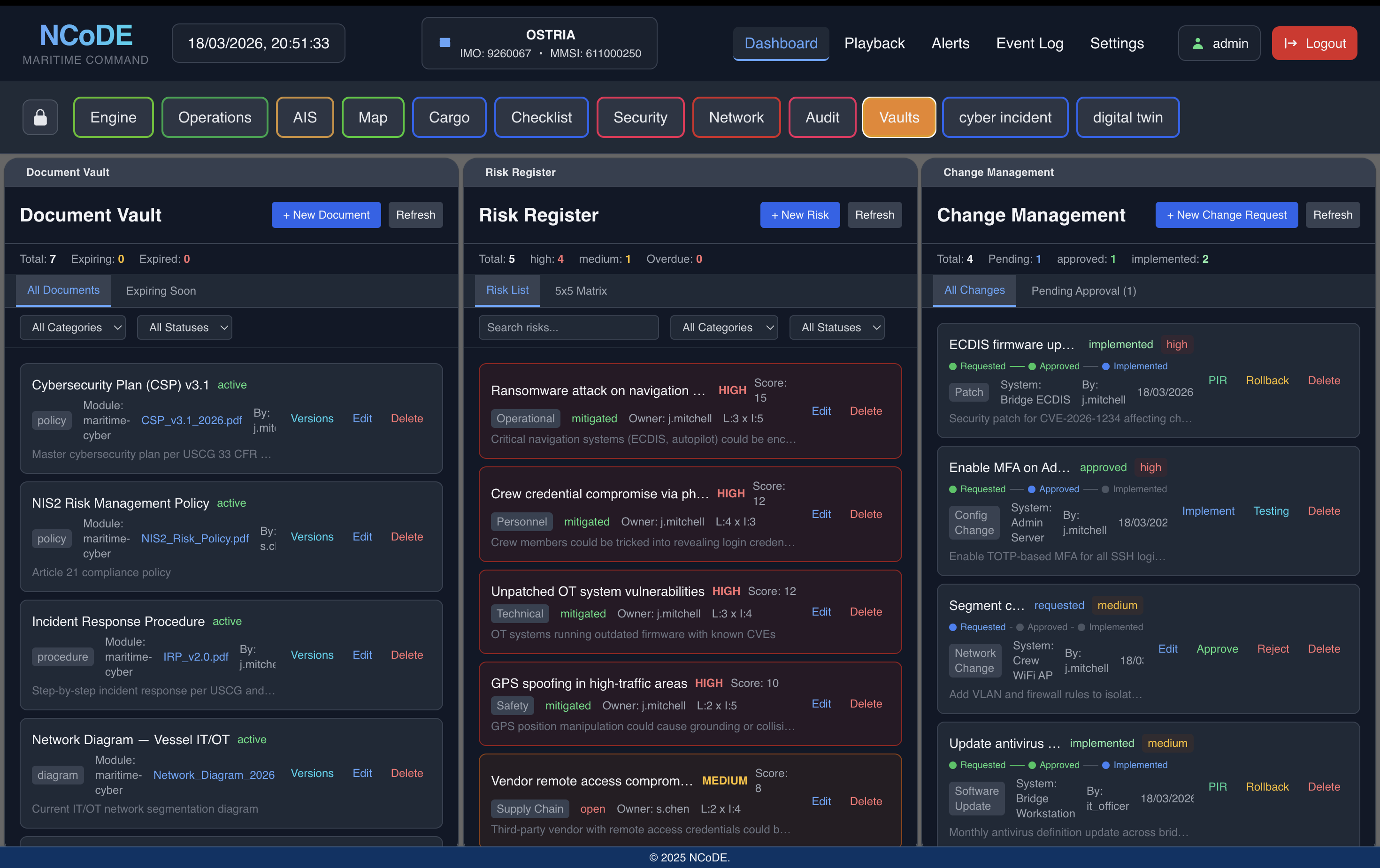
NCoDE Command brings together operations, compliance, and security into a unified command interface. Here's what it looks like in practice.
Live CCTV feeds, marine gauges, interactive charts with weather overlays, sensor data grid, battery monitoring, and network status - all in one customisable dashboard.
Multi-framework compliance tracking for USCG, NIS2, and IMO requirements. Vendor tracker, risk register, and controls implementation - with real-time compliance scoring.
Document vault for cybersecurity policies and procedures, risk register with severity tracking, and change management with approval workflows - all audit-ready.
Modern vessels run dozens of systems - navigation, propulsion, HVAC, security cameras, network equipment - but operators still manage compliance with spreadsheets, paper checklists, and disconnected tools.
Data lives in silos. The bridge has one view, the engine room another, shore management a third. Nobody has the complete picture.
When the inspector arrives, you're scrambling through folders, emails, and spreadsheets to prove compliance. It doesn't have to be this way.
Shared passwords, no audit logs, and unclear permissions make it impossible to prove who did what and when - exactly what regulators now require.
Shore-side management can't see vessel status in real time. When something goes wrong, you find out late - or not at all.
NCoDE Command integrates with your existing vessel systems and presents their data through a single, secure command interface. It's not a replacement - it's the layer that connects everything.
Navigation, engines, tanks, batteries, environmental sensors, and more - all displayed in real-time dashboards you can customise for any role.
Live video streams from onboard cameras with 72-hour DVR recording. See what's happening on deck, in the engine room, or at the gangway.
Enterprise-grade user authentication with roles, permissions, and certifications. Every login, every action - logged and auditable.
Integrated vulnerability scanning, security alerts, and patch status for every networked device aboard. Know your exposure before the inspector does.
Multi-framework compliance tracking for USCG, IMO, NIS2, SOLAS, ISM, and more. Every control mapped. Every evidence item captured.
Monitor every WAN link - VSAT, LTE, satellite - with bandwidth usage, signal strength, and device tracking in one view.
The shift from fragmented, manual processes to integrated, audit-ready operations. This is what inspectors expect - and what operators deserve.
| Challenge | Without NCoDE | With NCoDE |
|---|---|---|
| Cyber compliance | Spreadsheets and paper checklists with no framework tracking | Multi-framework compliance tracker with control-level evidence |
| Vulnerability management | Manual PC audits with no centralised visibility | Automated vulnerability scanning across all shipboard systems |
| Access control | Shared passwords, manual logs, no audit trail | Role-based access with complete authentication audit trail |
| Incident response | Paper-based plans, no structured workflow | Guided workflow with severity classification and NRC reporting |
| Vendor security | Email-based assessments, no tracking | Vendor database with remote access logging and DPA tracking |
| Document control | File shares with no version control or expiry tracking | Document Vault with versioning, expiry alerts, and access logs |
| Risk assessment | Static spreadsheet that nobody updates | Dynamic risk matrix with mitigation tracking and ownership |
| Change management | Informal approval via email or conversation | Change Control Board: request, review, approve, implement |
| Audit readiness | Scrambling to gather evidence when the inspector arrives | Complete digital audit trail ready for inspection at any time |
| Patch management | No visibility into patch status across shipboard systems | Full lifecycle tracking: open → scheduled → applied → verified. Deferred patches auto-create risk entries |
| Backup verification | Assume backups work — no verification until disaster strikes | Schedule tracking with RPO/RTO targets, restore testing records, and overdue detection alerts |
| Training compliance | Spreadsheet of crew certificates with manual expiry checks | LDAP-integrated training matrix with 30/60/90-day expiry warnings and per-role compliance percentage |
| Regulatory reporting | Manual forms filled under pressure, missed deadlines | Dedicated panels for USCG NRC, NIS2 Article 23 (three-stage), and IMO SMS chain with automated deadline tracking |
NCoDE Command serves the crew on board and the compliance team ashore. The same data, the same platform — different views for different responsibilities.
One incident. Multiple frameworks. Automated deadlines. NCoDE manages the entire lifecycle so nothing falls through the cracks.
Expanded decision tree covers ransomware, DDoS, supply chain, insider threats, and GPS spoofing. System recommends workflows automatically.
System creates structured incident descriptions, impact assessments, and containment steps. Detects safety-critical system involvement automatically.
Select frameworks and the system auto-creates every deadline: USCG NRC immediate + 30-day, NIS2 24h/72h/30d, IMO SMS + flag state.
Dedicated panels: NRC form, NIS2 three-stage (early warning → detailed → final), and IMO SMS chain (Captain → DPA → Company → Flag State).
NCoDE works with your existing systems. No rip-and-replace. It sits on top of your infrastructure and unifies the data into one command interface.
NMEA 2000, NMEA 0183 - GPS, depth, heading, speed, weather
Modbus, J1939, CAN Bus - RPM, temperatures, pressures, run hours
RTSP, ONVIF - live streams and 72-hour DVR recording
Peplink, VSAT, LTE/5G - bandwidth, signal, device tracking
LDAP - user accounts, roles, permissions, certifications
Wazuh SIEM - vulnerability scans, alerts, compliance checks
Fuel, water, grey water, black water - levels and alarms
Battery banks, generators, shore power - voltage, charge state
NCoDE includes dedicated compliance modules that map directly to USCG, IMO, NIS2, ISM, and classification society requirements. Each module generates the evidence an inspector expects.
Multi-framework compliance tracking, key personnel management, incident response workflow, penetration test scheduling, and NRC reporting - all in one module.
5×5 likelihood-impact risk matrix with mitigation tracking, risk ownership, and review scheduling. The formal risk assessment required by ISM Code and USCG cyber rules.
Controlled document storage with version history, expiry tracking, access logging, and role-based permissions. ISM-compliant document management.
Full change control workflow: request, review, approve, implement, rollback. Every modification to safety-critical systems documented and authorised.
Third-party vendor assessment with security scoring, remote access logging, Data Processing Agreement tracking, and access control.
User access control with roles, permissions, groups, and certification tracking. Every login audited. Every permission documented.
Full state machine: open → scheduled → applied → verified. Deferred patches auto-create risk entries. Applied patches generate change management records. Wazuh SCA import for automated findings.
Schedule tracking with RPO and RTO targets per system. Verification records with restore testing. Overdue detection at 1.5× warning and 2× critical frequency thresholds.
Crew-by-certification grid with 30, 60, and 90-day expiry warnings. Per-role compliance percentage. Bulk assignment after drills. Fully integrated with LDAP crew directory.
Per-agent software baseline management. Global allowlist for approved packages. Automated violation detection when unapproved software appears on any monitored endpoint.
NCoDE serves everyone from the master on the bridge to the DPA in the shore office - giving each role the view they need.
Single platform for operational safety, cyber compliance, and crew management
Complete cyber risk management with vulnerability scanning and incident response
ISM compliance evidence, audit logs, and document control from one system
Audit-ready evidence for every regulatory framework in a structured format
Submit regulatory reports, approve patches and changes, manage vendors and training — all remotely while the crew runs the ship
Aggregated compliance across all vessels via NCoDE Fleet. Drill down to individual vessel status and comparative analytics
NCoDE Command brings your vessel's operations, cyber security, and regulatory compliance into one unified platform. One interface. Every system. Complete governance.